



Flexibility mechanisms had been outlined within the Kyoto Protocol (COP3) as other ways to realize emissions discount as a part of the trouble to deal with local weather change points. These have been extremely controversial as they had been primarily included on sturdy US insistence and to maintain the US within the treaty. These fall into the next classes mentioned under:
Emissions Buying and selling
Emissions Buying and selling, or Carbon Buying and selling as it’s alternatively identified, includes buying and selling carbon emission credit inside nations.
- Allowances flip emissions right into a commodity that may be traded between industries.
- By beginning with a restrict which might progressively be decreased every year, the rest emissions are then accessible to make use of, or commerce if you don’t use them your self.
- As limits are decreased every year firms have to search out methods to cut back their emissions, by innovation and alter or commerce.
Supporters say that this mechanism will herald non-public companies by placing a worth on carbon, creating market pressures driving for effectivity, innovation and the most effective outcomes.
The Kyoto Protocol says that it’s okay to commerce in emissions, however that it shouldn’t be the main means to realize one’s commitments.
Some European nations and companies have began implementing such applications to get a head begin and to see how nicely it is going to work, whereas in Chicago, USA, a inexperienced home fuel emissions buying and selling market is rising. Chicago and Mexico Metropolis are, for instance, becoming a member of the carbon buying and selling initiative.
The proponents of carbon buying and selling consider that such markets will be helpful in gaining expertise and growing normal framework for monitoring emissions. It will possibly additionally assist in discovering the worth of decreasing GHGs [greenhouse gases]. However opponents really feel that stress ought to be on enterprise actual reductions by chopping fossil gasoline use inflicting GHG emissions moderately than on buying the appropriate to pollute by shopping for emission allowances.
Critics argue that it is going to be simpler to purchase credit than to cut back emissions therefore it gained’t actually work and can simply be a license to pollute.
Due to the collapse of the previous Soviet Union, the emissions from the nations of the previous Soviet Union is far decreased, however below the Kyoto agreements, they’ll emit as much as their 1990 limits. In essence then, buying and selling at 1990 limits may result in extra emissions, as summarized by the next:
[I]n the interval as much as 2012,
hot-airbuying and selling may truly result in a rise in world emissions. Beneath the Kyoto Protocol, Russia and the Ukraine secured the appropriate to stabilise their emissions at 1990 ranges by 2012. Since their economies collapsed after 1990, Russia and the Ukraine’s emissions are at present far under 1990 ranges. On paper, these two nations will thus be allowed to extend their emissions by 50% and 120% respectively by 2012. Nevertheless, their industries won’t conceivably be capable to develop this quick. As an alternative, they’ll be capable to promote a lot of that entitlement to different nations. America has already made clear its intention to buy thissizzling airto be able to obtain a considerable proportion of its discount requirement.
Clear Improvement Mechanism
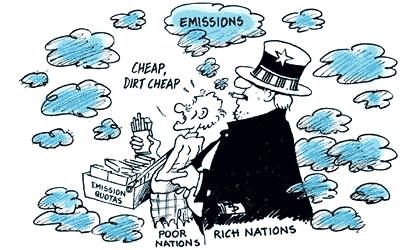
The Clear Improvement Mechanism (CDM) is just like the joint implementation, however the place developed nations spend money on Southern, or growing nations. It’s aimed to be part of a program of sustainable growth.
For some growing nations, that is essential due to the doable attraction of international funding.
Nevertheless, there have been many issues:
- Critics argue that wealthy nations can keep away from duties at house and that it’s going to truly improve emissions as a result of the credit earned will enable wealthy nations to emit extra, whereas growing nations usually are not tied to discount at this stage (as a result of it’s unfair to penalize them for what’s internationally acknowledged as largely one thing brought on by the wealthy nations. See the Local weather Justice and Fairness part for extra about this side.)
- It is usually criticized that as a substitute of essential know-how switch to growing nations (in order that they’re empowered to develop and produce themselves), the free-trade mechanisms will as a substitute result in additional dependency (and, paradoxically, on the very multinational companies which can be criticized for being the heaviest polluters.)
- By treating emissions as commodities, the structural inequity we see between North and South in commodity buying and selling usually is feared to proceed.
- In essence then, that is criticized for permitting the wealthy nations to proceed utilizing and burning fossil gasoline whereas paying the third world to not.
- Moreover, as Centre for Science and Surroundings (CSE) factors out, the wealthy get to make use of the poor nations’ land to deal with their very own emissions points, to not assist the poor, whereas not truly concentrating on decreasing emissions. The Company Europe Observatory additionally has issues on this space:
Many company ventures which may turn into eligible for emissions credit — nuclear energy crops, so-called
clear coal
crops in addition to industrial agriculture and large-scale tree plantations (together with genetically engineered varieties) — have extraordinarily severe damaging social and environmental impacts. Investments incarbon sinks
(corresponding to large-scale tree plantations) within the South would end in land getting used on the expense of native individuals, speed up deforestation, deplete water sources and improve poverty. Entitling the North to purchase low-cost emission credit from the South, by tasks of an usually exploitative nature, constitutescarbon colonialism
. Industrialised nations and their companies will harvest thelow-hanging fruit
(the most cost effective credit), saddling Southern nations with solely costly choices for any future discount commitments they is likely to be required to make.Saving
the Kyoto Protocol Means Ending the Market Mania, Company Europe Observatory, July 2001 - It is usually controversial as a result of many questions had been raised for the Hague convention. For instance:
- Limits have not been agreed to (or it has not even been agreed if there ought to be limits.)
- It isn’t clear what the vary of actions are that may be included. Nuclear power, hydropower, renewable power solely are among the uncertainties.
- Public participation and monitoring is paramount.
- Will a type of power tax work?
- Accountability and verifiability of emissions and credit and so on may be very troublesome as shares and flows of emissions are arduous to quantify.
- Futhermore, because the Company Europe Observatory factors out, the commerce in emissions leading to carbon credit would result in
unequal property rights to the ambiance
which in flipwould consolidate the historic overuse by Northern business on the expense of the South (80% of all CO2 emitted since 1850 has come from the North). A market with out clearly outlined property rights can by no means operate and the unfair property rights that underlie the at present proposed emissions markets will finally be rejected by these shedding out.
- As CSE additional level out to the lead as much as the COP8 assembly in October 2002, CDM continues to be a difficulty:
Robust guidelines for permanence, additionality, leakage, assessing the impression on the native inhabitants and measures to cut back uncertainty have to be utilized in any other case CDM would simply find yourself being an affordable manner for industrialised nations to satisfy their targets with out making any modifications domestically.
What’s Up for Dialogue at CoP-8?, CSE Briefing Notice, October 25, 2002 (hyperlink is to a PDF-formatted article.)




Leave a Reply