



Creator and Web page info
- This web page: https://www.globalissues.org/article/35/foreign-aid-development-assistance.
- To print all info (e.g. expanded aspect notes, exhibits different hyperlinks), use the print model:
Overseas support or (improvement help) is commonly thought to be being an excessive amount of, or wasted on corrupt recipient governments regardless of any good intentions from donor international locations. In actuality, each the amount and high quality of support have been poor and donor nations haven’t been held to account.
There are quite a few types of support, from humanitarian emergency help, to meals support, army help, and so on. Improvement support has lengthy been acknowledged as essential to assist poor growing nations develop out of poverty.
In 1970, the world’s wealthy international locations agreed to present 0.7% of their GNI (Gross Nationwide Earnings) as official worldwide improvement support, yearly. Since that point, regardless of billions given every year, wealthy nations have hardly ever met their precise promised targets. For instance, the US is commonly the biggest donor in greenback phrases, however ranks amongst the bottom by way of assembly the acknowledged 0.7% goal.
Moreover, support has typically include a value of its personal for the growing nations:
- Help is commonly wasted on situations that the recipient should use overpriced items and companies from donor international locations
- Most support doesn’t really go to the poorest who would wish it probably the most
- Help quantities are dwarfed by wealthy nation protectionism that denies market entry for poor nation merchandise, whereas wealthy nations use support as a lever to open poor nation markets to their merchandise
- Giant tasks or large grand methods typically fail to assist the susceptible as cash can typically be embezzled away.
This text explores who has benefited most from this support, the recipients or the donors.
On this web page:
- Governments Slicing Again on Promised Obligations
- Overseas Help Numbers in Charts and Graphs
- Are numbers the one subject?
- Help as a international coverage software to help the donor not the recipient
- Help Quantities Dwarfed by Results of First World Subsidies, Third World Debt, Unequal Commerce, and so on
- However support may very well be useful
- Commerce and Help
- Bettering Financial Infrastructure
- Use support to Empower, to not Prescribe
- Wealthy donor international locations and support bureaucracies usually are not accountable
- Democracy-building is prime, however more durable in lots of growing international locations
- Failed international support and continued poverty: well-intentioned errors, calculated geopolitics, or a combination?
Governments Slicing Again on Promised Obligations
Commerce, not support
is thought to be an vital a part of improvement promoted by some nations. However within the context of worldwide obligations, additionally it is criticized by many as an excuse for wealthy international locations to chop again support that has been agreed and promised on the United Nations.
Wealthy Nations Agreed at UN to 0.7% of GNP To Help
The help is to return from the roughly 22 members of the OECD, often known as the Improvement Help Committee (DAC). [Note that terminology is changing. GNP, which the OECD used up to 2000 is now replaced with the similar GNI, Gross National Income which includes a terms of trade adjustment. Some quoted articles and older parts of this site may still use GNP or GDP.]
ODA is mainly support from the governments of the rich nations, however doesn’t embrace personal contributions or personal capital flows and investments. The primary goal of ODA is to advertise improvement. It’s subsequently a sort of measure on the priorities that governments themselves placed on such issues. (Whether or not that essentially displays their citizen’s needs and priorities is a distinct matter!)
Virtually all wealthy nations fail this obligation
Regardless that these targets and agendas have been set, 12 months after 12 months virtually all wealthy nations have continuously failed to achieve their agreed obligations of the 0.7% goal. As a substitute of 0.7%, the quantity of support has been round 0.2 to 0.4%, some $150 billion quick every year.
Some donate many {dollars}, however are low on GNI p.c
Some fascinating observations may be made in regards to the quantity of support. For instance:
- USA’s support, by way of share of their GNP has virtually all the time been decrease than some other industrialized nation on this planet, although paradoxically since 2000, their greenback quantity has been the best.
- Between 1992 and 2000, Japan had been the biggest donor of support, by way of uncooked {dollars}. From 2001 the USA claimed that place, a 12 months that additionally noticed Japan’s quantity of support drop by almost 4 billion {dollars}.
Help rising since 2001 however nonetheless manner under obligations
All through the Nineties, ODA declined from a excessive
of 0.33% of whole DAC support in 1990 to a low of 0.22% in 1997. 2001 onwards has seen a development of elevated support. Facet ObserveThe UN famous the irony that the decline in support got here at a time the place situations have been enhancing for its larger effectiveness . In response to the World Financial institution, general, the official improvement help worldwide had been reducing about 20% since 1990.
Between 2001 and 2004, there was a continuous improve in support, however a lot of it attributable to geo-strategic considerations of the donor, resembling combating terrorism. Will increase in 2005 have been largely attributable to huge debt aid for Iraq, Nigeria, plus another one-off massive gadgets.
(As will likely be detailed additional under, support has sometimes adopted donor’s pursuits, not essentially the recipients, and as such the poorest haven’t all the time been the main focus for such support. Moreover, the numbers, as little as they’re, are literally extra flattering to donor nations than they need to be: the unique definition of support was by no means supposed to incorporate debt aid or humanitarian emergency help, however as an alternative was meant for improvement functions. That is mentioned additional under, too.)
Overseas Help Numbers in Charts and Graphs
And who will get what?
Help cash is definitely manner under what has been promised
Facet observe on personal contributions
As an apart, it needs to be emphasised that the above figures are evaluating authorities spending. Such spending has been agreed at worldwide stage and is unfold over quite a few priorities.
Particular person/personal donations could also be focused in some ways. Nevertheless, though the charts above do present US support to be poor (in share phrases) in comparison with the remaining, the generosity of the American folks is much extra spectacular than their authorities. Non-public support/donation sometimes by the charity of particular person folks and organizations may be weighted to sure pursuits and areas. Nonetheless, it’s fascinating to notice for instance, based mostly on estimates in 2002, Individuals privately gave not less than $34 billion abroad — greater than twice the US official international support of $15 billion at the moment:
- Worldwide giving by US foundations: $1.5 billion per 12 months
- Charitable giving by US companies: $2.8 billion yearly
- American NGOs: $6.6 billion in grants, items and volunteers.
- Spiritual abroad ministries: $3.4 billion, together with well being care, literacy coaching, aid and improvement.
- US schools scholarships to international college students: $1.3 billion
- Private remittances from the US to growing international locations: $18 billion in 2000
- Supply: Dr. Carol Adelman, Help and Consolation, Tech Central Station, 21 August 2002.
Though Adelman admitted that there aren’t any full figures for worldwide personal giving
she nonetheless claimed that Individuals are clearly probably the most beneficiant on earth in public—however particularly in personal—giving
. Whereas her assertions needs to be taken with warning, the numbers are excessive.
Rating the Wealthy based mostly on Dedication to Improvement
Non-public donations and philanthropy
Authorities support, whereas fraught with issues (mentioned under), displays international coverage aims of the donor authorities in energy, which might differ from the generosity of the folks of that nation. It will also be much less specialised than personal contributions and targets are internationally agreed to be measurable.
Non-public donations, particularly massive philanthropic donations and enterprise givings, may be topic to political/ideological or financial end-goals and/or topic to particular curiosity. A vivid instance of that is in well being points around the globe. Amazingly massive donations by foundations such because the Invoice and Melinda Gates Basis are spectacular, however the underlying causes of the issues usually are not addressed, which require political options. As Rajshri Dasgupta feedback:
Non-public charity is an act of privilege, it will possibly by no means be a viable different to State obligations,mentioned Dr James Obrinski, of the organisation Medicins sans Frontier, in Dhaka lately on the Individuals’s Well being Meeting (see Himal, February 2001). In a nutshell, business and personal donations are feel-good, short-term interventions and no substitute for the vastly bigger, and basically political, process of bringing well being care to greater than a billion poor folks.
As one other instance, Invoice Gates introduced in November 2002 a large donation of $100 million to India over ten years to struggle AIDS there. It was huge information and really welcome by many. But, on the similar time he made that donation, he was making one other bigger donation—over $400 million, over three years—to extend help for Microsoft’s software program improvement suite of purposes and its platform, in competitors with Linux and different rivals. Thomas Inexperienced, in a considerably cynical article, questions who actually advantages, saying And being a monster MS [Microsoft] shareholder himself, a
(Emphasis is authentic.)Large Win
in India will enrich him [Bill Gates] personally, maybe properly in extra of the $100 million he’s donating to the AIDS drawback. Makes you surprise who the actual beneficiary of charity is right here.
India has probably one tenth of the world’s software program builders, so capturing the market there of software program improvement platforms is seen as essential. This is only one amongst many examples of what seems extraordinarily welcome philanthropy and charity additionally having different motives. It is perhaps seen as horrible to criticize such charity, particularly on an important subject resembling AIDS, however that’s not the difficulty. The priority is that whereas it’s welcome that this charity is being supplied, at a systemic stage, such charity is unsustainable and exhibits ulterior motives. Would Invoice Gates have donated that a lot had there not been further pursuits for the corporate that he had based?
As well as, as award-winning investigative reporter and writer Greg Palast additionally notes, the World Commerce Group’s Commerce-Associated Mental Property Rights (TRIPS), the rule which helps Gates rule, additionally bars African governments from shopping for AIDS, malaria and tuberculosis medication at low-cost market costs.
He additionally provides that it’s killing extra folks than the philanthropy saving. What Palast is hinting in the direction of is the unequal guidelines of commerce and economics which are a part of the world system, that has contributed to international locations resembling most in Africa being unable to handle the scourge of AIDS and different issues, even once they need to. See for instance, the sections on free commerce, poverty and firms on this web page for extra.
The LA Instances has additionally discovered that the Gates Basis has been investing in questionable firms which are typically concerned in environmental air pollution, even youngster labor, and extra.
Along with personal contributions, on the subject of authorities support, these considerations can multiply as it could have an effect on the financial and political path of a whole nation if such authorities support can be tied into political aims that profit the donor.
Are numbers the one subject?
As we’ll see additional under, some support has certainly been fairly damaging for the recipient, whereas on the similar time being useful for the donor.
Help is Really Hampering Improvement
See additionally, for instance, the well-regarded Actuality of Help venture for extra on the fact and rhetoric of support. This venture appears at what numerous nations have donated, and the way and the place it has been spent, and so on.
Non-public flows typically don’t assist the poorest
Whereas ODA’s prime function is to advertise improvement, personal flows are sometimes considerably bigger than ODA. Throughout financial booms, extra funding is noticed in quickly rising economies, for instance. However this doesn’t essentially imply the poorest nations get such funding.
Throughout the growth of the mid-2000s earlier than the international monetary disaster sub-Saharan Africa didn’t appeal to as a lot funding from the wealthy nations, for instance (although when China determined to spend money on Africa, wealthy nations regarded on this suspiciously fearing exploitation, virtually ignoring their very own many years of exploitation of the continent. China’s curiosity is no-doubt motivated by self-interest, and time should inform whether or not there may be certainly exploitation occurring, or if African nations will be capable of demand honest situations or not).
As personal flows to growing international locations from multinational firms and funding funds replicate the pursuits of traders, the significance of Abroad Improvement Help can’t be ignored.
Moreover, (and detailed under) these whole flows are lower than the subsidies most of the wealthy nations give to a few of their industries, resembling agriculture, which has a direct affect on the poor nations (attributable to flooding the market with—or dumping—extra merchandise, defending their very own markets from the merchandise of the poor international locations, and so on.)
As well as, quite a lot of different inter-related points, resembling geopolitics, worldwide economics, and so on all tie into support, its effectiveness and its function. Africa is commonly highlighted as an space receiving extra support, or in want of extra of it, but, in recent times, it has seen much less support and fewer funding and so on, all of the whereas being subjected to worldwide insurance policies and agreements which have been detrimental to many African folks.
For the June 2002 G8 summit, a briefing was ready by Motion for Southern Africa and the World Improvement Motion, wanting on the wider subject of financial and political issues:
It’s plain that there was poor governance, corruption and mismanagement in Africa. Nevertheless, the briefing reveals the context—the legacy of colonialism, the help of the G8 for repressive regimes within the Chilly Warfare, the creation of the debt entice, the huge failure of Structural Adjustment Programmes imposed by the IMF and World Financial institution and the deeply unfair guidelines on worldwide commerce. The function of the G8 in creating the situations for Africa’s disaster can’t be denied. Its overriding accountability have to be to place its personal home so as, and to finish the unjust insurance policies which are inhibiting Africa’s improvement.
Because the above briefing is titled, a typical theme on these points (around the globe) has been to blame the sufferer
. The above briefing additionally highlights some frequent myths
typically used to spotlight such points, together with (and quoting):
- Africa has obtained rising quantities of support through the years—in actual fact, support to Sub-Saharan Africa fell by 48% over the Nineties
- Africa must combine extra into the worldwide economic system—in actual fact, commerce accounts for bigger proportion of Africa’s revenue than of the G8
- Financial reform will generate new international funding—in actual fact, funding to Africa has fallen since they opened up their economies
- Unhealthy governance has precipitated Africa’s poverty—in actual fact, in line with the UN Convention on Commerce and Improvement (UNCTAD), financial situations imposed by the IMF and the World Financial institution have been the dominant affect on financial coverage within the twenty years to 2000, a interval through which Africa’s revenue per head fell by 10% and revenue of the poorest 20% of individuals fell by 2% per 12 months
The amount subject is an enter into the help course of. The standard is in regards to the output. We see from the above then, that the amount of support has not been as a lot appropriately. However what in regards to the high quality of the help?
Help seems to have established as a precedence the significance of influencing home coverage within the recipient international locations
As proven all through this web page (and lots of of others) one of many root causes of poverty lies within the highly effective nations which have formulated many of the commerce and support insurance policies at the moment, that are extra to do with sustaining dependency on industrialized nations, offering sources of low-cost labor and cheaper items for populations again dwelling and rising private wealth, and sustaining energy over others in numerous methods. As talked about within the structural adjustment part, so-called lending and improvement schemes have completed little to assist poorer nations progress.
The US, for instance, has additionally held again dues to the United Nations, which is the biggest physique making an attempt to supply help in such a wide range of methods to the growing international locations. Former US President Jimmy Carter describes the US as stingy
:
Whereas the US supplied massive quantities of army support to international locations deemed strategically vital, others famous that the US ranked low amongst developed nations within the quantity of humanitarian support it supplied poorer international locations.
We’re the stingiest nation of all,former President Jimmy Carter mentioned lately in an tackle at Principia Faculty in Elsah, Sick.
Evan Osbourne, writing for the Cato Institute, additionally questioning the effectiveness of international support and famous the pursuits of quite a few different donor international locations, in addition to the U.S., of their support methods in previous years. For instance:
- The US has directed support to areas the place it has considerations associated to its nationwide safety, e.g. Center East, and in Chilly Warfare occasions specifically, Central America and the Caribbean;
- Sweden has targetted support to
progressive societies
; - France has sought to advertise upkeep or protect and unfold of French tradition, language, and affect, particularly in West Africa, whereas disproportionately giving support to those who have intensive business ties with France;
- Japan has additionally closely skewed support in the direction of these in East Asia with intensive business ties along with situations of Japanese purchases;
Osbourne additionally added that home stress teams (company foyer teams, and so on) have additionally confirmed fairly adept at steering support to their favored recipients.
And so, If support shouldn’t be significantly given with the intention to foster financial development, it’s maybe not shocking that it doesn’t obtain it.
Help Cash Usually Tied to Numerous Restrictive Situations
Of their 2000 report wanting again on the earlier 12 months, the Actuality of Help 2000 (Earthscan Publications, 2000, p.81), reported of their US part that 71.6% of its bilateral support commitments have been tied to the acquisition of products and companies from the US.
That’s, the place the US did give support, it was most frequently tied to international coverage aims that will assist the US.
Main as much as the UN Convention on Financing for Improvement in Monterrey, Mexico in March 2002, the Bush administration promised a virtually $10 billion fund over three years adopted by a everlasting improve of $5 billion a 12 months thereafter. The EU additionally supplied some $5 billion improve over the same time interval.
Whereas these will increase have been welcome, these targets are nonetheless under the 0.7% promised on the Earth summit in Rio de Janeiro in 1992. The World Financial institution have additionally leveled some criticism of previous insurance policies:
Commenting on the newest US pledge [of $10 billion], Julian Borger and Charlotte Denny of the Guardian (UK) say Washington is determined to deflect consideration in Monterrey from the scale of its support price range. However for extra beneficiant donors, says the story, Washington’s conversion to the reason for efficient support spending is difficult to swallow. Among the many huge donors, the US has the worst report for spending its support price range on itself—70 p.c of its support is spent on US items and companies. And greater than half is spent in center revenue international locations within the Center East. Solely $3bn a 12 months goes to South Asia and sub-Saharan Africa.
As well as, guarantees of more cash have been tied to extra situations, which for a lot of growing international locations is one other barrier to actual improvement, because the situations are generally favorable to the donor, not essentially the recipient. Delhi-based Centre for Science and Surroundings commented on the US conditional pledge of more cash that:
Thus, establishment in world relations is maintained. Wealthy international locations just like the US proceed to have a monetary lever to dictate what good governance means and to pry open markets of growing international locations for multinational firms. Growing international locations haven’t any such deal with for Northern markets, even in sectors like agriculture and textiles, the place they’ve a bonus however proceed to face commerce boundaries and subsidies. The estimated annual price of Northern commerce boundaries to Southern economies is over US $100 billion, rather more than what growing international locations obtain in support.
One other facet of support tying into pursuits of donors is exemplified with local weather change negotiations. Highly effective nations resembling the USA have been vocally towards the Kyoto Protocol on local weather change. In contrast to smaller international locations, they’ve been in a position to exert their affect on different international locations to push for bilateral agreements conditioned with support, in a manner that some would describe as a bribe. Middle for Science and Surroundings for instance criticizes such politics:
It’s straightforward to be taken in with guarantees of bilateral support, and make seemingly innocuous commitments in bilateral agreements. There’s far an excessive amount of at stake right here [with climate change]. To additional their pursuits, smaller, poorer international locations don’t have support to bribe and commerce muscle to threaten international locations.
This use of energy in political and financial arenas is nothing new. Highly effective nations have all the time managed to exert their affect in numerous arenas. Throughout the Gulf Warfare in 1991 for instance, many who ended up within the allied coalition have been promised numerous concessions behind the scenes (what the media described as diplomacy
). For instance, Russia was supplied large IMF cash. Even now, with the difficulty of the Worldwide Legal Court docket, which the US can be against, it has been pressuring different nations on a person foundation to not signal, or present concessions. In that context, support is commonly tied to political aims and it may be tough to generally see when it isn’t so.
However some forms of situations hooked up to help will also be ideologically pushed. For instance, quoted additional above by the New York Instances, James Wolfensohn, the World Financial institution president famous how European and American farm subsidies are crippling Africa’s likelihood to export its manner out of poverty.
Whereas this criticism comes from many views, Wolfensohn’s observe on export additionally means that some types of improvement help could also be on the situation that nations reform their economies to sure ideological positions. Structural Adjustment has been one in all these major insurance policies as a part of this neoliberal ideology, to advertise export-oriented improvement in a quickly opened economic system. But, this has been one of the crucial disastrous insurance policies prior to now twenty years, which has elevated poverty. Even the IMF and World Financial institution have hinted now and again that such insurance policies usually are not working. Individuals can perceive how tying support on situation of enhancing human rights, or democracy is perhaps interesting, however when tied to financial ideology, which isn’t all the time confirmed, or not all the time following the one dimension suits all
mannequin, the flexibility (and accountability) of selections that governments must pursue insurance policies they consider will assist their very own persons are lowered.
Extra Cash Is Transferred From Poor Nations to Wealthy, Than From Wealthy To Poor
For the OECD international locations to satisfy their obligations for support to the poorer international locations shouldn’t be an financial drawback. It’s a political one. This may be seen within the context of different spending. For instance,
- The US lately elevated its army price range by some $100 billion {dollars} alone
- Europe subsidizes its agriculture to the tune of some $35-40 billion per 12 months, even whereas it calls for different nations to liberalize their markets to international competitors.
- The US additionally launched a $190 billion greenback subsidy to its farms by the US Farm Invoice, additionally criticized as a protectionist measure.
- Whereas support quantities to round $70 to 100 billion per 12 months, the poor international locations pay some $200 billion to the wealthy every year.
- There are lots of extra (some talked about under too).
In impact then, there may be extra support to the wealthy than to the poor.
Whereas the quantity of support from some international locations such because the US may look very beneficiant in sheer greenback phrases (ignoring the share subject for the second), the World Financial institution additionally identified that on the World Financial Discussion board in New York, February 2002, [US Senator Patrick] Leahy famous that two-thirds of US authorities support goes to solely two international locations: Israel and Egypt. A lot of the remaining third is used to advertise US exports or to struggle a struggle towards medication that would solely be gained by tackling drug abuse in the USA.
In October 2003, at a United Nations convention, UN Secretary Common Kofi Annan famous that
growing international locations made the sixth consecutive and largest ever switch of funds to
different international locationsin 2002, a sum totallingvirtually $200 billion.
Funds needs to be shifting from developed international locations to growing international locations, however these numbers inform us the other is occurring…. Funds that needs to be selling funding and development in growing international locations, or constructing colleges and hospitals, or supporting different steps in the direction of the Millennium Improvement Objectives, are, as an alternative, being transferred overseas.
And as Saradha Lyer, of Malaysia-based Third World Community notes, as an alternative of selling funding in well being, schooling, and infrastructure improvement within the third world, this cash has been channelled to the North, both due to debt servicing preparations, asymmetries and imbalances within the commerce system or due to inappropriate liberalization and privatization measures imposed upon them by the worldwide monetary and buying and selling system.
This switch from the poorer nations to the wealthy ones makes even the latest improve in ODA appear little compared.
Help Quantities Dwarfed by Results of First World Subsidies, Third World Debt, Unequal Commerce, and so on
Combining the above talked about reversal of flows with the subsidies and different distorting mechanisms, this all quantities to some huge cash being transferred to the richer international locations (also referred to as the worldwide North), in comparison with the entire support quantities that goes to the poor (or South).
In addition to having a direct affect on poorer nations, it additionally impacts smaller farmers in wealthy nations. For instance, Oxfam, criticizing EU double requirements, highlights the next:
Latin America is the worst-affected area, dropping $4bn yearly from EU farm insurance policies. EU help to agriculture is equal to double the mixed support budgets of the European Fee and all 15 member states. Half the spending goes to the most important 17 per cent of farm enterprises, belying the manufactured fantasy that the CAP [Common Agriculture Policy] is all about conserving small farmers in jobs.
The double requirements that Oxfam mentions above, and that numerous others have highlighted has a huge effect on poor international locations, who’re pressured to observe liberalization and decreasing authorities interference
whereas wealthy nations are in a position to subsidize a few of their industries. Poor international locations consequently have a fair harder time competing. IPS captures this properly:
On the one hand, OECD international locations such because the US, Germany or France proceed by the ECAs [export credit agencies] to subsidise exports with taxpayers’ cash, typically in detriment to the competitiveness of the poorest international locations of the world,says [NGO Environment Defence representative, Aaron] Goldzimmer.Then again, the official improvement help which is one strategy to help the international locations of the South to discover a sustainable path to improvement and progress is being lowered.…
Authorities subsidies imply appreciable price discount for main firms and quantity to round 10 per cent of annual world commerce. Within the 12 months 2000, subsidies by ECAs added as much as 64 billion {dollars} of exports from industrialised international locations, properly above the official improvement help granted final 12 months of 51.4 billion {dollars}.
In addition to agriculture, textiles and clothes is one other mainstay of many poor international locations. However, as with agriculture, the wealthier international locations have lengthy held up boundaries to stop being out-competed by poorer nation merchandise. This has been achieved by issues like subsidies and numerous agreements
. The affect to the poor has been far-reaching, as Buddies of the Earth highlights:
Regardless of the apparent significance of the textile and clothes sectors by way of improvement alternatives, the North has persistently and systematically repressed growing nation manufacturing to guard its personal home clothes industries.
Because the Seventies the textile and clothes commerce has been managed by the Multi-Fibre Association (MFA) which units bilateral quotas between importing and exporting international locations. This was supposedly to guard the clothes industries of the industrialised world whereas they tailored to competitors from growing international locations. Whereas there are circumstances the place such safety could also be warranted, particularly for transitionary intervals, the MFA has been in place since 1974 and has been prolonged 5 occasions. In response to Oxfam, the MFA is,
…probably the most vital..[non tariff barrier to trade]..which has confronted the world’s poorest international locations for over 20 years.Though the MFA has been changed by the Settlement on Textiles and Clothes (ATC) which phases out help over an extra ten 12 months interval—albeit by a course of which in itself is extremely inequitable—growing international locations are nonetheless struggling the implications. The entire price to growing international locations of restrictions on textile imports into the developed world has been estimated to be some $50 billion a 12 months. This is kind of equal to the entire quantity of annual improvement help supplied by Northern governments to the Third World.
January 24, 2001
There’s typically a lot speak of commerce somewhat than support, of improvement, of opening markets and so on. However, when on the similar time among the vital markets of the US, EU and Japan look like no-go areas for the poorer nations, then such speak has been criticized by some as being hole. The New York Instances is price quoting at size:
Our compassion [at the 2002 G8 Summit talking of the desire to help Africa] could also be properly meant, however additionally it is hypocritical. The US, Europe and Japan spend $350 billion every year on agricultural subsidies (seven occasions as a lot as international support to poor international locations), and this cash creates gluts that decrease commodity costs and erode the residing customary of the world’s poorest folks.
These subsidies are crippling Africa’s likelihood to export its manner out of poverty,mentioned James Wolfensohn, the World Financial institution president, in a speech final month.Mark Malloch Brown, the top of the United Nations Improvement Program, estimates that these farm subsidies price poor international locations about $50 billion a 12 months in misplaced agricultural exports. By coincidence, that’s about the identical as the entire of wealthy international locations’ support to poor international locations, so we take again with our left hand each cent we give with our proper.
It’s holding down the prosperity of very poor folks in Africa and elsewhere for very slender, egocentric pursuits of their very own,Mr. Malloch Brown says of the wealthy world’s agricultural coverage.It additionally appears a tad hypocritical of us to complain about governance in third-world international locations after we enable tiny teams of farmers to hijack billion of {dollars} out of our taxes.
Actually, J. Brian Atwood, stepped down in 1999 as head of the US international support company, USAID. He was very crucial of US insurance policies, and vented his frustration that regardless of many well-publicized commerce missions, we noticed just about no improve of commerce with the poorest nations. These nations couldn’t have interaction in commerce as a result of they might not afford to purchase something.
(Quoted from a speech that he delivered to the Abroad Improvement Council.)
As Jean-Bertrand Arisitde additionally factors out, there may be additionally a boomerang impact of loans as massive parts of support cash is tied to purchases of products and commerce with the donor:
Many within the first world think about the sum of money spent on support to growing international locations is huge. Actually, it quantities to solely 0.3% of GNP of the industrialized nations. In 1995, the director of the US support company defended his company by testifying to his congress that 84 cents of each greenback of support goes again into the US economic system in items and companies bought. For each greenback the USA places into the World Financial institution, an estimated $2 really goes into the US economic system in items and companies. In the meantime, in 1995, severely indebted low-income international locations paid one billion {dollars} extra in debt and curiosity to the Worldwide Financial Fund (IMF) than they obtained from it. For the 46 international locations of Subsaharan Africa, international debt service was 4 occasions their mixed governmental well being and schooling budgets in 1996. So, we discover that support doesn’t support.
In different phrases, typically support doesn’t support the recipient, it aids the donor. For the US within the above instance, its support company has been a international coverage software to boost its personal pursuits, efficiently.
After which there was the disastrous meals support insurance policies, which is one other instance of offering support however utilizing that support as an arm of international coverage aims. It has helped their firms and enormous farmers at an enormous price to growing international locations, and has seen a rise in starvation, not discount. For extra particulars, see all the part on this web site that discusses this, within the Poverty and Meals Dumping a part of this web page.
For the world’s hungry, nevertheless, the issue isn’t the stinginess of our support. When our ranges of help final boomed, below Ronald Reagan within the mid-Eighties, the emphasis was hardly on eliminating starvation. In 1985, Secretary of State George Shultz acknowledged flatly that
our international help applications are important to the achievement of our international coverage targets.However Shultz’s assertion shouldn’t shock us. Each nation’s international support is a software of international coverage. Whether or not that support advantages the hungry is decided by the motives and targets of that coverage—by how a authorities defines the nationwide curiosity.
The above quote from the ebook World Starvation is from Chapter 10, which can be reproduced in full on this web page. It additionally has extra details and stats on US support and international coverage aims, and so on.
As an apart, it’s fascinating to notice the disparities between what the world spends on army, in comparison with different worldwide obligations and commitments. Most rich nations spend far extra on army than improvement, for instance. The United Nations, which will get its monies from member nations, spends about $10 billion—or about 3% of what simply the US alone spends on its army. It’s dealing with a monetary disaster as international locations such because the US need to cut back their burden of the prices—which comparatively is sort of low anyway—and have tried to withhold funds or continued in line with numerous further situations.
And with the latest monetary disaster, clearly the act of getting sources collectively shouldn’t be the difficulty, as much more has been made accessible in only a few quick months than a whole 4 many years of support:
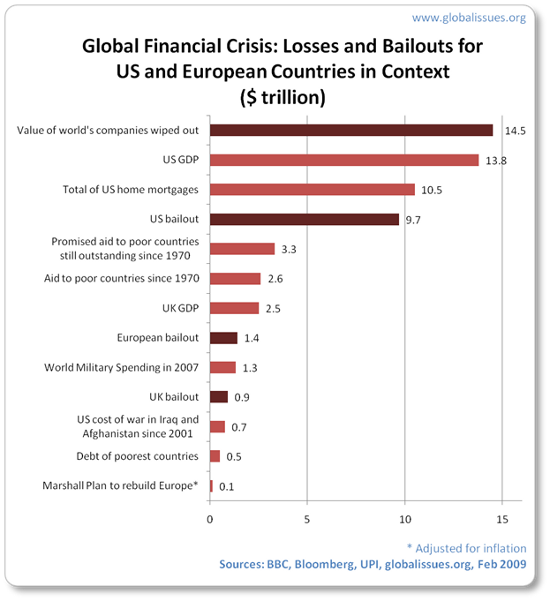
However, because the quote above highlights as properly, in addition to the quantity of support, the high quality of support is vital. (And the above highlights that the standard has not been good both.)
However support may very well be useful
Authorities support, from the USA and others, as indicated above can typically fall foul of political agendas and pursuits of donors. On the similar time that’s not the one support going to poor international locations. The US itself, for instance, has an extended custom of encouraging charitable contributions. Certainly, tax legal guidelines within the US and numerous European international locations are favorable to such giving as mentioned additional above. However personal funding, philanthropy and different sources of support can even fall foul of comparable or different agendas, in addition to problems with focus on some areas over others, of accountability, and so forth. (Extra on these points is launched on this web site’s NGO and Improvement part.)
Commerce and Help
Oxfam highlights the significance of commerce and support:
Some Northern governments have confused that
commerce not supportneeds to be the dominant theme on the [March 2002 Monterrey] convention [on Financing for Development]. That method is disingenuous on two counts. First, wealthy international locations have didn’t open their markets to poor international locations. Second, elevated support is significant for the world’s poorest international locations if they’re to understand the alternatives supplied by commerce.
Along with commerce not support
views, the Bush Administration was eager to push for grants somewhat than loans from the World Financial institution. Grants being free cash seems to be extra welcome, although many European nations aren’t as happy with this selection. Moreover, some commentators level out that the World Financial institution, being a Financial institution, shouldn’t give out grants, which might make it compete with different grant-offering establishments resembling numerous different United Nations our bodies. Additionally, there may be concern that it could be simpler to impose political situations to the grants. John Taylor, US Undersecretary of the Treasury, in a latest speech in Washington additionally identified that Grants usually are not free. Grants may be simply be tied to measurable efficiency or outcomes.
Some remark that maybe grants might result in extra dependencies in addition to some nations might comply with much more situations whatever the penalties, as a way to get the free cash. (Extra about the difficulty of grants is mentioned by the Bretton Woods Venture.)
In discussing commerce insurance policies of the US, and EU, in relation to its results on poor international locations, chief researcher of Oxfam, Kevin Watkins, has been very crucial, even charging them with hypocrisy for preaching free commerce however working towards mercantilism:
Trying past agriculture, it’s tough to keep away from being struck by the discrepancy between the image of US commerce coverage painted by [US Trade Representative, Robert] Zoellick and the realities dealing with growing international locations.
To take one instance, a lot has been product of America’s generosity in the direction of Africa below the Africa Development and Alternative Act (AGOA). This gives what, on the floor, appears like free market entry for a variety of textile, garment and footwear merchandise. Scratch the floor and also you get a distinct image. Underneath AGOA’s so-called rules-of-origin provisions, the yarn and cloth used to make attire exports have to be made both in the USA or an eligible African nation. If they’re made in Africa, there’s a ceiling of 1.5 per cent on the share of the US market that the merchandise in query can account for. Furthermore, the AGOA’s protection is lower than complete. There are some 900 tariff strains not coated, for which common tariffs exceed 11%.
In response to the Worldwide Financial Fund (IMF), the advantages accruing to Africa from the AGOA can be some $420m, or 5 occasions, larger if the US eliminated the rules-of-origin restrictions. However these restrictions replicate the realities of mercantilist commerce coverage. The underlying precept is you could export to America, supplied that the export in query makes use of American merchandise somewhat than these of rivals. For a rustic supposedly main a campaign for open, non-discriminatory international markets, it’s a curiously anachronistic method to commerce coverage.
Watkins lists quite a few different areas, in addition to the AGOA which are beset with issues of hypocrisy, and concludes that nihilism and blind pursuit of US financial and company particular curiosity represents an impediment to the creation of a world buying and selling system able to extending the advantages of globalisation to the world’s poor.
(See additionally this web site’s part on free commerce and globalization, the place there may be extra criticism about northern international locations exhibiting mercantilist, or monopoly capitalist rules, somewhat than free market capitalism, though that’s what is preached to the remainder of the world.)
In that context then, and given the issues talked about additional above about agricultural and textiles/clothes subsidies, and so on. the present quantity of support given to poor international locations doesn’t examine to support
given to wealthier international locations’ firms and industries and hardly compensates for what’s misplaced.
Each rising and restructuring support to actually present growing international locations the instruments and means to develop for themselves, for instance, would assist recipients of support, not simply the donors. Help is extra than simply charity and can’t be separated from different problems with politics and economics, which should even be thought-about.
Bettering Financial Infrastructure
Commerce not Help
seems like first rate rhetoric. Because the economist Amartya Sen for instance says, lots that may be completed at a comparatively little price. Sadly, up to now, it appears that evidently rhetoric is generally what it has turned out to be.
As well as, as J.W. Smith additional qualifies, somewhat than giving cash that may be squandered away, maybe the perfect type of support can be business, immediately:
Do Not Give the Needy Cash: Construct Them Industries As a substitute
With the report of corruption inside impoverished international locations, folks will query giving them cash. That may be dealt with by giving them the business immediately, not the cash. To construct a balanced economic system, present shopper shopping for energy, and develop arteries of commerce that can take in the manufacturing of those industries, contractors and labor in these international locations needs to be used. Legitimacy and safety of contracts is the premise of any sound economic system. Engineers know what these prices needs to be and, if price overruns begin coming in, the contractor who has confirmed incapable needs to be changed—simply as any good contract would require…. When supplied the business, versus the cash to construct business, these folks can have bodily capital. The one earnings to be made then are in manufacturing; there isn’t any improvement cash to intercept and ship to a Swiss checking account.
on-line)
Whether or not the hope for efficient international support will really flip into actuality is more durable to know, due to energy politics, which has characterised and formed the world for hundreds of years.
A danger for growing international locations that look to help, not less than of their short-term plans to kick-start improvement (for changing into depending on support over the long term appears a harmful path to observe), is that folks of the wealthy world will see the failures of support with out seeing the detailed explanation why, making a backlash of donor fatigue, reluctance and cynicism.
Creator and Web page Data
- Created:
- Final up to date:


Leave a Reply